Asbestos Refurbishment and Demolition Survey: When You Need One and What It Involves
- A refurbishment and demolition survey is needed before any work that will disturb the fabric of a pre-2000 building, not just before demolition.
- It is fully intrusive. The surveyor breaks into voids, lifts floors and opens up finishes, so the area is vacated and certified before people go back in.
- It can be limited to the areas the works will touch. A whole-building survey is only required for demolition or a full strip-out.
- The results go into the asbestos register, and anything the works will disturb is removed or made safe before the contractor starts.
A management survey tells you where asbestos is so you can live with it safely. A refurbishment and demolition survey tells you what is behind the walls, above the ceilings and under the floors before someone takes them apart. If you are about to fit out, strip out, extend, re-roof or demolish any part of a building built or refurbished before 2000, this is the survey the law expects you to have first. This guide covers when it is required, what the surveyor actually does, what it costs and what happens with the results.
What a refurbishment and demolition survey is
HSE’s survey guide, HSG264, defines two kinds of asbestos survey. The management survey is the routine one: it locates asbestos-containing materials that could be disturbed during normal occupation and maintenance, with minimal intrusion. The refurbishment and demolition survey, often shortened to an R&D survey, is the one for building work. Its purpose is to find every asbestos-containing material in the area where the works will take place, including materials hidden inside the structure, so that they can be removed or protected before the work begins.
The difference is not academic. A management survey will not have looked inside a boxed-in riser, behind a plasterboard lining or under a screed. A refurbishment survey will.
When it is required
Regulation 5 of the Control of Asbestos Regulations 2012 requires an employer not to carry out work that could expose people to asbestos unless a suitable assessment has been made of whether asbestos is present. For a building built or refurbished before 2000, the practical way to meet that is a refurbishment and demolition survey of the areas the works will affect. The duty holder under regulation 4 is expected to make that information available to anyone who may disturb the fabric.
In practice that means a survey before:
- An office or retail fit-out that removes partitions, ceilings or floor finishes.
- Mechanical and electrical work that runs new services through voids, risers or ducts.
- Re-roofing, window replacement or cladding works.
- Extensions, structural alterations and any work that opens up walls or floors.
- Partial or full demolition.
Buildings constructed after 2000 do not normally need one, because asbestos was banned in the UK in November 1999. If the construction date is uncertain, treat the building as pre-2000.
What the survey involves
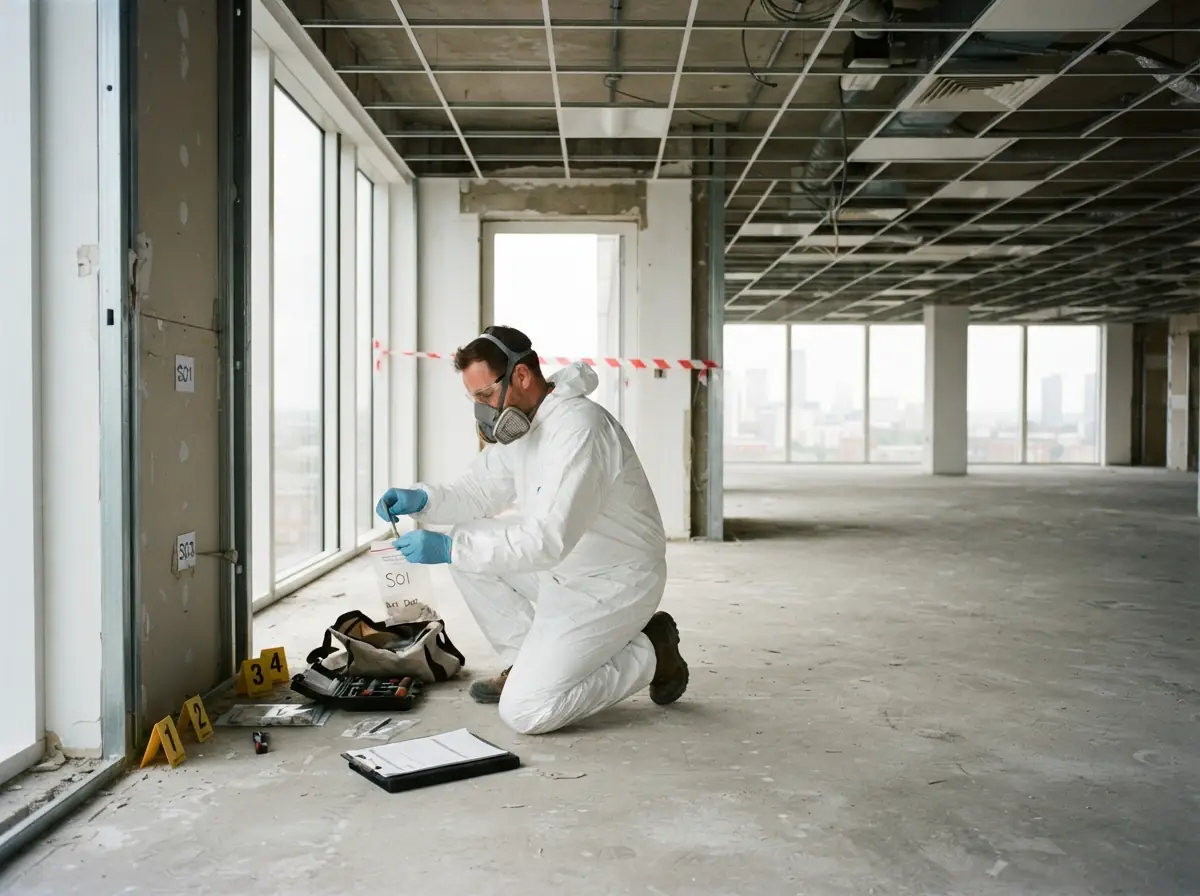
This is a destructive inspection. The surveyor will break into ceiling voids, lift floorboards and tiles, cut into wall linings, open up service ducts and bulkheads, and examine behind fixed fittings in every part of the area the works will reach. Samples of suspect materials go to a laboratory for analysis, and the survey is not complete until the results are back.
Because the inspection disturbs materials that may contain asbestos, HSG264 expects the area to be vacated for the duration and, where asbestos is found or disturbed, certified fit for reoccupation before anyone goes back in. For an occupied building that means planning the survey around the tenant, usually out of hours or area by area.
The report records every material found, its location, type and condition, and a risk assessment for each, with photographs and plans. It should state clearly which areas were inspected and any that could not be accessed, because an exclusion is a gap in the works plan, not a clean bill of health.
How much of the building it covers
A refurbishment survey only has to cover the area where the works will take place. A fit-out of one floor does not need the whole building opened up. A demolition survey, by contrast, covers the whole building or the part being demolished, including the structure. Agreeing the scope with the surveyor before the visit is where most of the cost control happens: give them the drawings and the specification, and let them survey what the contractor will actually touch, plus a sensible margin for the routes of new services.
Get a refurbishment survey quote
Tell us about the building and the works and we will match you with a qualified asbestos surveyor. No obligation.
Who can carry it out
The surveyor must be competent, with the training, experience and insurance for intrusive survey work. HSG264 recommends using a surveying organisation accredited by UKAS to ISO 17020, or an individual surveyor who can show equivalent competence, and sample analysis should be carried out by a UKAS-accredited laboratory. Ask to see the accreditation and the surveyor’s certificates, and make sure the quote covers the sampling and analysis, not just the site visit.
What it costs
Refurbishment surveys cost more than management surveys because they take longer, generate more samples and need making good afterwards. A localised survey of a single area, such as one floor of an office or a shop unit before a fit-out, tends to start from a few hundred pounds. Whole-building refurbishment and demolition surveys of larger premises run from around £900 to several thousand pounds, plus sample analysis, which is usually charged per sample. Our asbestos survey cost guide sets out the ranges in more detail. The number that matters is not the survey fee but the cost of a contractor downing tools when an unexpected material turns up halfway through a job.
What happens after the survey
The findings go into the building’s asbestos register and management plan. Anything the works will disturb is dealt with before the main contractor starts: removed by a licensed contractor where the material is licensable, removed or encapsulated under controlled conditions where it is not, and the area cleared and certified. Materials the works will not touch stay where they are, labelled and managed. The contractor should be given the survey report as part of the pre-construction information, and most will not start without it.
Getting a quote
Tell us about the building and the works and we will match you with a qualified asbestos surveyor who can scope the survey around your programme. Start on our asbestos survey page, or if you are not sure which survey you need, our guide to management versus refurbishment surveys sets out the difference.
Sources & further reading
- HSE HSG264: Asbestos, the survey guide — what a refurbishment and demolition survey must cover
- Control of Asbestos Regulations 2012, regulation 5 — identifying asbestos before work starts
- Control of Asbestos Regulations 2012, regulation 4 — the duty to manage
- HSE: the duty to manage asbestos — HSE guidance for duty holders
External links open in a new tab. ComSurv is a matching service, not a firm of surveyors, and is not affiliated with these organisations. This article is general information, not legal, surveying or valuation advice; take advice on your specific situation.