Emergency lighting tests
Monthly function tests and the annual full-duration test to BS 5266-1, with failed luminaires and batteries replaced.

Emergency Lighting & Fire Alarms
Tell us about the premises and its systems and we'll match you with one competent fire alarm and emergency lighting engineer who covers your area. Get a no-obligation quote in about a minute, and keep both systems tested, serviced and on record.
In short
The Fire Safety Order requires the responsible person to keep fire safety equipment, including emergency lighting and alarm systems, in efficient working order and good repair. The British Standards set the routine: emergency lighting gets a short monthly function test and an annual test for its full rated duration under BS 5266-1, and fire alarm systems get a weekly user test of a call point plus inspection and servicing by a competent person at intervals not exceeding six months under BS 5839-1. Every test goes in the logbook, which is what an inspector or insurer asks to see.
Maintained by the ComSurv team and checked against UK government, HSE and professional-body sources. ComSurv is a matching service, not a law firm; this is general information, not legal advice.
Why it matters
Two systems that only matter when something has gone wrong. Emergency lighting has to keep escape routes lit when the mains fails; the fire alarm has to detect and warn in time. Both are tested on a fixed cycle and both need a record.
Monthly function tests and the annual full-duration test to BS 5266-1, with failed luminaires and batteries replaced.
Six-monthly inspection and servicing to BS 5839-1: detectors, call points, sounders, panel and batteries.
Every test and visit recorded, which is the evidence your fire risk assessment relies on.
Defects found on a visit are reported with a quote, so nothing is left open.
How it works
Answer a few quick questions about the property, what you need and your timeline.
We match you with one of the competent fire alarm and emergency lighting engineers who cover your area and property type.
Get a no-obligation quote and go ahead only if it's right for you.
What's involved
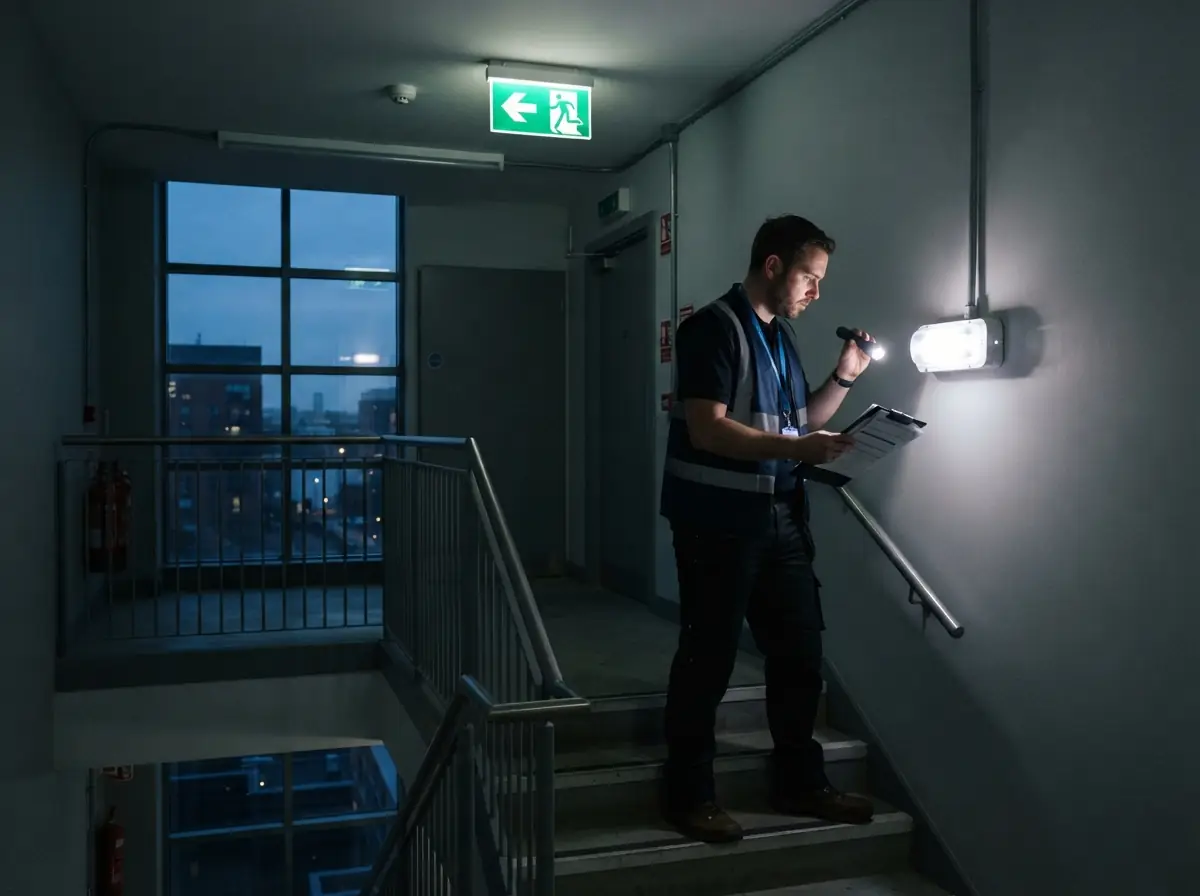
The engineer runs the emergency lighting on battery for the test period and checks every fitting and exit sign, then inspects and tests the fire alarm system: a sample of detectors and call points, the panel, sounders, standby batteries and any links to other systems. Findings go in the logbook with a certificate for the visit.
When the lights go out
People plan their escape around the signs and lights they expect to be there. A battery that has quietly died, a detector that has drifted out of tolerance, a panel showing a fault nobody cleared: none of it shows during a normal working day. The monthly and six-monthly routine is how you find out before a fire does.
Get my quoteQualified & accredited
The engineers we match you with work to BS 5266-1 and BS 5839-1 and hold recognised fire systems competence, with many registered under third-party schemes such as BAFE. ComSurv is a matching service and is not itself a regulated firm.
Qualified, regulated and accountable




Questions
A short monthly function test of every fitting and an annual test for the full rated duration, usually three hours, both recorded in the logbook, following BS 5266-1.
A weekly user test of a call point, plus inspection and servicing by a competent person at intervals not exceeding six months, following BS 5839-1. Two visits a year is the norm.
Where your fire risk assessment identifies that escape routes need it, yes. The Fire Safety Order requires fire safety equipment to be maintained in working order, and the risk assessment decides what equipment the premises need.
Usually, yes. Many fire systems contractors cover all three on the same visit, which keeps the logbook tidy and the cost down. Tell us what you need covered.
The engineer isolates the lighting circuits, or uses the test facility, so the emergency fittings run on battery for the rated duration. It is normally done at a quiet time so the premises can stay open.
Priced by the number of fittings and the size of the alarm system. Small premises are often covered by an annual contract of a few hundred pounds, with larger sites quoted on inspection. You will get a no-obligation quote.
Also required on this property
Most commercial premises carry more than one compliance duty. These are the ones that usually sit alongside this service, or that the same visit can cover.
Related guides
Free, no-obligation, and matched to one competent fire systems engineer who covers your area. Takes about a minute.
Get my quote