Guides · New Premises
Opening a Shop: The Premises Checklist for Your First Retail Unit
Key takeaways
- The public on your premises changes the fire risk assessment, the access duties and your liability. Plan for customers, not just staff.
- The shopfront and the sign are controlled three times over: the lease, planning and the advertisement regulations. Get consent before the sign is made.
- Every display, charger and demo unit is a portable appliance. PAT testing in a shop is set by risk and starts before you open.
- Business rates relief is not applied automatically. Apply the week you move in.
A shop is the most common first commercial unit, and the one where new tenants assume the least can go wrong. It is four walls and a till. But the moment a member of the public steps inside, the premises take on duties an office never has, and the shopfront you are itching to change is the part of the building the lease and the planning system guard most closely. This guide works through what a first retail unit needs, in order.
What a shop takes on that an office does not
Our main checklist covers the duties every tenant inherits with the keys. A shop adds one factor that changes several of them: members of the public who do not know the building.
- Your fire risk assessment must account for people who do not know the exits, including children, wheelchair users and anyone who arrived through the one door they know.
- You owe customers a duty of care for the state of the premises. A loose mat, a wet floor at the entrance or a display that can topple is your liability, which is why the lease will usually require public liability cover.
- You have a duty to make reasonable adjustments under the Equality Act, so that disabled customers can get in and be served.
- Deliveries, stock and packaging mean more waste and more things plugged in than a desk-based business.
None of this is difficult. It just has to be in the plan before opening day rather than discovered on it.
Before you sign: use, hours and the shopfront clause
Read these four clauses before anything else, alongside the paperwork checks in our guide to compliance before signing a lease.
Permitted use. In England, most shops sit in Class E, so switching between retail uses or from a shop to a café needs no planning permission. The lease can still restrict you to a narrow use, and some landlords in parades and centres keep a tenant mix by doing exactly that. Make sure the clause covers everything you intend to sell, including online fulfilment from the stockroom if that is part of the plan.
Keep-open and hours. Shopping centre and some parade leases contain a keep-open covenant requiring you to trade set hours. Breaching it is a breach of lease. Check it against the staffing you can afford.
Shopfront, signage and alterations. This clause usually says the shopfront cannot be changed without consent and the sign must be approved by the landlord. Agree your fascia design and any shopfront changes in writing before completion, so they are not a negotiation after you have committed.
Service charge. In a parade or centre you pay a share of the common parts, security and marketing. Ask for the last three years of accounts and the budget, and check the lease against the RICS professional statement on service charges, which sets out how a fair charge should be run.
Then get a schedule of condition. Shop units change hands often and the shopfront, floor and ceiling you inherit have usually been through three previous fit-outs. Under a full repairing lease their condition becomes yours to maintain unless the schedule records it.
The shopfront and the sign
The sign over the door is controlled three times. Each control is separate, and passing one does not pass the others.
- The lease. Covered above. Landlord approval of the design, usually in writing.
- Planning permission. Replacing or materially altering the shopfront, adding a shutter or changing the entrance usually needs planning permission. In a conservation area or on a listed building, almost any external change does. The Planning Portal’s guidance for shops sets out the common cases.
- Advertisement consent. Signs are governed by the Control of Advertisements Regulations. A standard fascia sign and one projecting sign usually have deemed consent, provided they stay within size and illumination limits and the building is not listed. Go outside those limits, add a second projecting sign or internally illuminate in a conservation area and you need express consent, which takes around eight weeks. The adverts and signs guidance explains where the line falls.
Order the sign only when all three are settled. A sign that has to come down is a sign paid for twice.
Fire safety when the public walk in
From the day you occupy, you are the responsible person for the unit under article 9 of the Fire Safety Order, and a recorded fire risk assessment is required before you trade. For a shop it needs to cover five things a general template often misses.
- Escape routes that stay clear of stock. The route from the back of the shop and from the stockroom to a final exit, kept free of deliveries and display stands, all year including December.
- The stockroom. Densely packed combustible stock, often with a charger or a kettle in the corner. It is frequently where the fire starts.
- Shutters and locked doors. A rear fire exit that is padlocked during trading hours is one of the most common findings in retail enforcement.
- Emergency lighting and signage on routes that customers do not know.
- Extinguishers sized to the floor area and the stock. Our guide to how many extinguishers a business needs gives the method.
In a shopping centre or a shop under flats, the building will have its own assessment covering common parts and shared alarm systems. Ask for it and make sure the two line up. Our guide to fire risk assessments in multi-let buildings explains where the boundary sits.
Compliance Check
Know what the unit needs before you fit it out
Run the free compliance check on the shop you are taking. Ten questions, and you get the list of duties that will be yours, with a quote for each.
Electrical: the displays, the till and the stockroom
Ask the landlord for the EICR before completion. If it is missing, more than five years old or unsatisfactory, commission your own before the fit-out. Shop units accumulate wiring from each previous tenant, and new display lighting, a till point and a stockroom socket run are often added on top of circuits that were never tested. Every new circuit must be certified on an Electrical Installation Certificate. Who holds the EICR duty between landlord and tenant is covered in this guide.
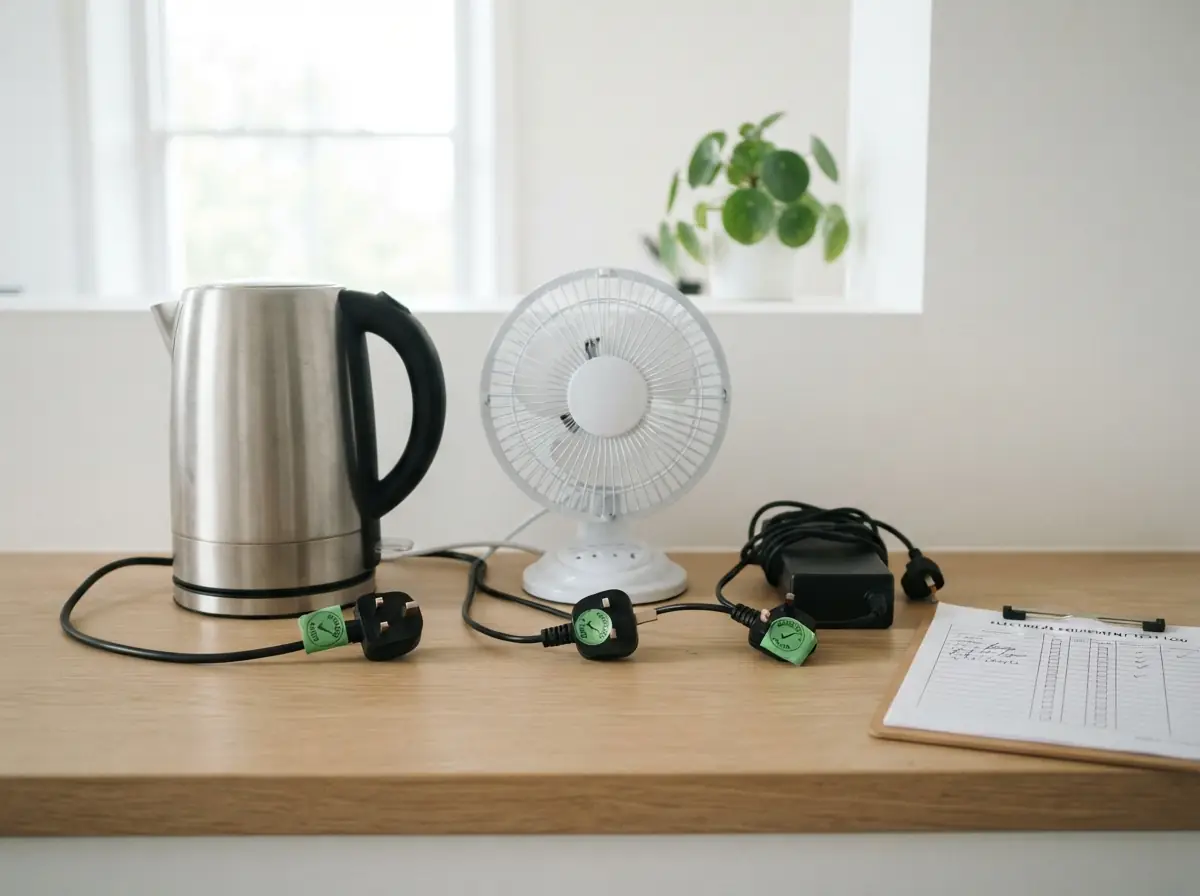
Then there is everything you plug in: display lighting on plugs, chargers, the card terminal, demo products, the kettle in the back. Each is a portable appliance. There is no legal annual interval, as the HSE’s PAT testing FAQ makes clear, but you must keep the equipment safe, and the practical way to show that is a test before opening and a risk-based interval afterwards. Our guide to whether PAT testing is a legal requirement sets out the position, and how often to test covers the intervals for a retail environment.
Access for every customer
Under section 20 of the Equality Act 2010, a business serving the public must make reasonable adjustments so that disabled customers are not at a substantial disadvantage, and that duty extends to the physical features of the premises. What is reasonable depends on the size of the business and the building, but a step at the door with no ramp, a counter nobody in a wheelchair can reach or an aisle too narrow to turn in are the common failures in a small shop. The duty is anticipatory: you are expected to have thought about it before a customer is turned away.
If your fit-out touches the entrance, the floor levels or the WC, the works have to meet Approved Document M of the building regulations. Build access into the fit-out design rather than retrofitting it, and keep a short written note of what you considered and what you did. It is your evidence if a complaint is made.
Rates, waste and the till
Business rates. Tell the council the day you occupy. Then apply for small business rate relief if the unit’s rateable value qualifies, and check whether retail, hospitality and leisure relief applies on top. Neither is automatic, and relief is rarely backdated beyond the current year.
Waste. Cardboard, packaging and returns cannot go in household bins. You need a commercial waste contract and transfer notes under the duty of care, and in England workplaces must separate recycling and food waste for collection. A shop in a centre usually has to use the centre’s contractor through the service charge.
Card payments. Order the terminal early enough to test it on the unit’s own internet connection, confirm it talks to your till or EPOS, and take a test sale and a refund before opening. We have partnered with DOJO, the UK’s No.1 payments provider, so you can get a quote as part of the same set-up.
Year one: what comes round again
- Fire extinguisher service: annual. Emergency lighting: monthly function test, annual full test. Fire risk assessment: reviewed when the layout changes, which in a shop is every season.
- PAT: at the interval you set by risk, with display and customer-facing items tested most often.
- EICR: at the interval the inspector recommends, typically up to five years for a shop.
- Legionella: if the unit has a water heater and a WC, a proportionate assessment and a review at least every two years. See legionella in small premises.
- Signage and shopfront: keep the consents on file. They transfer to the next tenant and reduce the reinstatement argument at lease end.
The compliance calendar lists every interval, and the free compliance check produces the list for your unit with a quote against each line.
Sources & further reading
- Regulatory Reform (Fire Safety) Order 2005, article 9 the fire risk assessment duty
- Planning Portal: shops shopfront changes and when permission is needed
- Planning Portal: adverts and signs deemed consent and its limits
- Town and Country Planning (Control of Advertisements) (England) Regulations 2007 the rules behind fascia and projecting signs
- Equality Act 2010, section 20 the duty to make reasonable adjustments
- Approved Document M: access to and use of buildings the access standard that applies to alterations
- HSE: portable appliance testing FAQ risk-based intervals, not annual by default
- GOV.UK: small business rate relief you must apply, it is not automatic
- GOV.UK: retail, hospitality and leisure relief the relief for occupied shops
- RICS: Service charges in commercial property what a fair service charge looks like in a parade or centre
- GOV.UK: managing your waste, an overview the duty of care on business waste
Questions
Frequently asked questions
Do I need planning permission to open a shop?
Usually not for the use itself, because in England most shops sit in Class E and a change within the class needs no permission. You will often need permission for changes to the shopfront, and signs are controlled separately under the advertisement regulations. The lease also has to permit your use.
Can I put up a sign without permission?
A standard fascia sign and one projecting sign usually have deemed consent under the Control of Advertisements Regulations, provided they stay within size and illumination limits and the building is not listed. Anything beyond that needs express consent from the council, and the lease will almost always require the landlord’s approval of the design as well.
Does a shop legally need a fire risk assessment?
Yes. Under the Regulatory Reform (Fire Safety) Order 2005 the person in control of the premises must carry out and record a fire risk assessment, and in a shop it must account for members of the public who do not know the exits. It must be in place before you trade and reviewed whenever the layout changes.
How often does a shop need PAT testing?
There is no fixed legal interval. The law requires electrical equipment to be maintained safely, and the HSE recommends a risk-based approach. In practice that means a test before opening, then shorter intervals for customer-facing displays, chargers and anything that moves, and longer ones for fixed equipment.
Do I have to make my shop wheelchair accessible?
You must make reasonable adjustments under the Equality Act 2010 so that disabled customers are not at a substantial disadvantage. What is reasonable depends on your size and the building, but you are expected to have considered access before a customer is turned away, and any fit-out works to the entrance or WC must meet Approved Document M.
How do I get business rates relief on a small shop?
Apply to your local council. Small business rate relief depends on the rateable value of the unit and whether you occupy other premises, and retail, hospitality and leisure relief may apply on top. Neither is applied automatically, so apply in the first week of occupation.